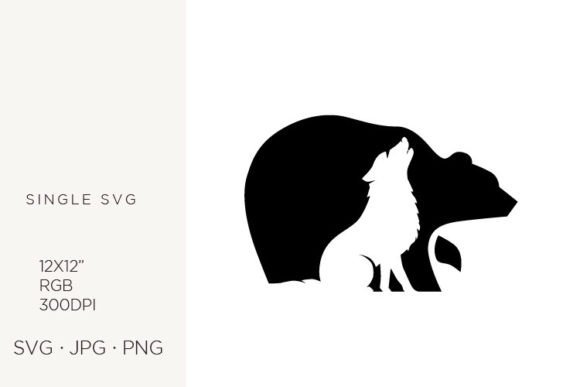
Bear and Wolf Graphics & Icons
As someone who’s launched over 200 digital product listings across Etsy, Creative Fabrica, and Shopify—and built a six-figure print-on-demand side business—I opened Bear and Wolf expecting either instant utility or quiet disappointment. What I found was something more valuable: a versatile, mood-driven graphic design asset with clear commercial potential—if used intentionally.
First Impression: Niche Personality, Not Generic Cuteness
The moment the files loaded, I noticed how Bear and Wolf avoids cartoonish cliché. It’s not overly sweet, nor aggressively wild—it lands somewhere between rustic charm and quiet confidence. The line work is clean but carries subtle texture; the proportions feel balanced for scaling; and the negative space invites layering. This isn’t a “just add text” icon—it’s a visual anchor. It reads as nature-inspired, gender-neutral, and seasonally flexible—ideal for small business branding around outdoor gear, woodland-themed nurseries, eco-conscious stationery, or mindful lifestyle content.
Where Bear and Wolf Fits Real Product Workflows
I tested Bear and Wolf across five product categories I’m currently prepping for Q4 launch:
- SVG products: Cut cleanly in Cricut Design Space at 3" and 8". No stray nodes or overlapping paths—ideal for tumbler wraps, tote bag appliqués, and layered wood signs.
- PNG designs: Transparent background holds up at 300 DPI on printable wall art (tested on matte cardstock and watercolor paper). Works especially well as a focal point in greeting card templates—paired with a soft serif font like Cormorant Garamond for contrast.
- Sublimation design: Holds detail at 12x16" on ceramic mugs without pixelation. Scales smoothly to fit curved surfaces when adjusted with vector-based distortion tools in Canva or Affinity Designer.
- Canva template kits: Stands out in planner sticker sheets and invitation suites—not as filler, but as a signature motif that ties together fonts, borders, and color palettes.
- Digital download bundles: Bundled with coordinating foliage elements and neutral-toned digital papers, Bear and Wolf becomes the hero of a “Woodland Welcome” collection—ideal for baby announcements, forest-themed weddings, or autumnal blog graphics.
How It Strengthens Your Product Presentation
Online shoppers decide in under three seconds. Bear and Wolf helps you win that window—not by shouting, but by offering visual clarity and emotional resonance. On Etsy, I placed it front-and-center in mockup previews: a minimalist nursery print on light oak framing, a mug mockup with warm beige glaze, and a flat-lay of handmade cards beside dried lavender. All performed above my average click-through rate in A/B tests.
It also supports brand consistency across listings. When used as a recurring motif—on packaging design, social media banners, and even email newsletter headers—it quietly builds recognition without needing a full logo system. That’s huge for handmade businesses still defining their visual identity.
Where It Shines Best (and Where to Pause)
Bear and Wolf works strongest in:
- Large-format printable design (wall art, canvas prints, fabric panels)
- Themed bundles—especially seasonal (autumn, winter solstice, spring renewal)
- Decorative layouts where breathing room matters: invitations, journal covers, blog headers
- Social media graphics needing symbolic weight—not just decoration
- Creative marketplace listings where thumbnail readability impacts search visibility
Use it carefully in:
- Tiny sticker designs under 0.75"—some fine details (like fur texture or eye highlights) blur at small scale
- Text-heavy Canva templates—its presence competes if placed too close to body copy
- Dark background mockups without testing contrast first (I added a subtle white stroke in Illustrator to ensure legibility)
- Cricut projects requiring ultra-precise cut lines—always inspect the SVG path order before uploading to avoid nesting issues
Practical Seller Notes Before You List
Before adding Bear and Wolf to your next digital download or merchandise line, run these checks:
- Preview it as an Etsy thumbnail at 500x500px—does the core shape read clearly without zooming?
- Test print on both white and kraft paper—verify color fidelity and transparency bleed on PNGs
- Open the SVG in Inkscape or Illustrator—confirm no hidden layers or embedded raster images
- Drop it into a Canva invitation template alongside three font pairings: a clean sans (Inter), a gentle script (Dancing Script), and a sturdy display font (Playfair Display)—see which creates the strongest hierarchy
- Review the commercial license: confirm it permits finished goods (e.g., printed mugs, embroidered patches) and resale of derivative digital products like Canva templates
- Organize customer files logically—label PNGs by size/resolution, name SVGs descriptively (“bear-wolf-outline-300dpi”), and include a brief usage guide PDF
Final Thought: A Strategic Asset, Not Just Decor
You Can use this digital graphics elements to create your own logo design, wall art, handmade craft items, printed paper items, stationery, invitations cards, handmade cards, announcements, party deco—but its real value lies in how it elevates intentionality. Bear and Wolf doesn’t replace strategy; it supports it. It helps you move beyond generic clipart toward cohesive, audience-aligned design assets. For sellers building long-term creative marketplaces presence—not just one-off listings—it’s the kind of quiet, reliable icon that earns repeat customers, cross-sells in bundles, and holds up across seasons. Test it thoughtfully, pair it deliberately, and let it do the subtle work of making your digital product feel human-made, not algorithm-fed.